
CONCRETE SEALING IN OCALA AND ALL FOUR COUNTIES FOR DRIVEWAYS, PATIOS, POOL DECKS, WALKWAYS, GARAGE FLOORS WITH STAMPED CONCRETE, BREATHABLE FLORIDA-GRADE SEALER, PENETRATING AND ACRYLIC OPTIONS
Ocala's Climate Is Hard on Concrete. Sealing Is the Defense.
Looking for professional concrete sealing in Ocala, Florida? Starr's & Stripes Power Wash provides specialized concrete cleaning and penetrating sealer application for driveways, patios, walkways, and commercial entryways across Marion, Sumter, Citrus, and Levy Counties. Owners Randy and Matt Starr deliver a two-coat protection process using breathable water-based sealers—blocking oil stains, tire marks, moisture intrusion, and mold growth in matte, natural, or wet-look finishes.
Breathable Sealing That Works in Florida
The most important thing to understand about concrete sealing in Florida is breathability. Concrete sits on grade — ground moisture is always present below the slab, moving upward as vapor. A non-breathable sealer traps that vapor under the film. Pressure builds. The sealer blisters, delaminates, and peels — often within months of application. This is why many homeowners who have tried hardware store concrete sealer in Florida have had disappointing results.
Professional concrete sealing in Florida uses breathable sealer chemistry that blocks liquid water penetration while allowing moisture vapor to pass through the seal. Water and staining compounds cannot get in. Ground moisture vapor can get out. The slab is protected without the vapor pressure failure mode that ruins non-breathable film-forming sealers in Florida’s climate.
Starr’s & Stripes seals concrete driveways, patios, pool decks, walkways, garage floors, and stamped decorative concrete across Marion, Citrus, Levy, and Sumter Counties. Breathable professional-grade sealer appropriate to each surface type and application.
Four Ways Florida's Climate Degrades Unprotected Concrete.
Concrete is one of the most durable building materials available — but it is not impervious. Its porous matrix absorbs what it is exposed to, and what Florida exposes it to is particularly aggressive: year-round moisture, extreme UV, biological growth that operates twelve months per year, and the full range of staining compounds that accumulate on any outdoor surface. Sealing does not make concrete invulnerable. It makes it significantly more resistant to each of the four mechanisms below — and resistant surfaces last decades longer than unprotected ones.
Moisture Intrusion and Vapor Cycling -- The Internal Damage
How it happens: Concrete is porous. Liquid water and moisture vapor move through its matrix in response to humidity differentials between the surface environment and the ground below the slab. In Florida, ground moisture is constant — the water table is shallow, rainfall is abundant, and irrigation systems add additional moisture to the soil around and beneath concrete slabs. This moisture cycles through unsealed concrete continuously, carrying dissolved minerals, salts, and biological material with it.
Florida acceleration: The Floridan Aquifer sits close to the surface throughout Marion County and the surrounding service area. Soil moisture content is elevated year-round compared to drier climates. Florida’s summer wet season — June through October — adds significant water volume to the soil surrounding every concrete slab through daily rainfall and irrigation. Moisture cycling in Central Florida concrete is not a seasonal event. It is continuous.
Cost of ignoring it: Sustained moisture cycling weakens the calcium silicate hydrate bonds in the concrete matrix over time. Dissolved minerals carried by moisture cycling deposit as efflorescence on the surface. Moisture in the concrete creates conditions for biological growth establishment in surface pores. Early-stage moisture damage is invisible — the concrete looks unchanged while the matrix is being gradually compromised. Sealing stops liquid water penetration and provides a vapor-permeable barrier that allows ground moisture to escape without carrying damaging compounds into the surface.
UV Degradation -- Surface Chemistry Breakdown
How it happens: Ultraviolet radiation attacks the cement paste that holds concrete aggregate together at the surface. Over years of UV exposure, the cement paste in the top layer of unsealed concrete breaks down — a process called carbonation — leaving aggregate particles less firmly bonded to the surface. The result is a chalky, dusty surface layer that erodes progressively under traffic and rain. Colored concrete loses pigment. Stamped concrete loses the color depth and detail that makes it worth the premium installation cost.
Florida acceleration: Florida’s latitude gives it UV intensity 40 to 60 percent higher than northern states. The UV index in Ocala regularly reaches extreme levels (11+) during summer months. Concrete surfaces in direct sun experience full UV intensity with no seasonal relief — there is no cloudy winter period in Central Florida that allows surface recovery. UV degradation in Florida operates at a rate that accelerates what would be a gradual multi-year process in lower-UV environments.
Cost of ignoring it: Standard gray concrete that has lost surface integrity from UV degradation begins to erode under vehicle traffic — tire wear pulls surface aggregate loose, creating a progressively roughening surface. Colored and stamped concrete without UV-protective sealer can lose most of its installed color within three to five years of Ocala sun exposure. Once color is lost from decorative concrete, restoration is costly and imperfect. Sealing preserves what is present and slows further degradation significantly.
Biological Growth -- Surface Chemistry Attack
How it happens: Algae, mold, mildew, and lichen establish in the surface pores of unsealed concrete when moisture and organic matter create suitable conditions. Biological growth is not merely cosmetic — the organic acids produced by algae and lichen chemically attack cement paste, widening surface pores and creating surface roughness that accumulates more organic debris and accelerates further growth. Lichen specifically produces oxalic acid that etches concrete surfaces over time.
Florida acceleration: Florida’s humid subtropical climate supports biological growth on outdoor surfaces twelve months per year. There is no frost period that kills established biological colonies. Ocala’s mature tree canopy in established neighborhoods creates shaded moisture conditions that maintain the humidity biological growth requires even in dry periods. Pool deck concrete, which is constantly wet, is the most aggressive biological growth environment on any residential property.
Cost of ignoring it: Unsealed concrete in shaded locations in Ocala can show biological growth establishment within six to twelve months of installation or last cleaning. Green or black biological staining on unsealed concrete indicates that growth has established in the surface pores rather than just on the surface — pressure washing removes the visible growth but leaves the anchored root structure behind, allowing rapid regrowth. Sealed concrete creates a surface barrier that biological growth cannot anchor into.
Staining -- Permanent Penetration of Porous Surfaces
How it happens: Unsealed concrete absorbs what contacts it. Oil from vehicle drips penetrates within minutes of contact. Fertilizer from lawn applications washes across concrete in rain and leaves chemical burns. Rust from well water irrigation deposits iron oxide on every surface the sprinkler reaches. Leaf tannin from oak trees stains concrete surfaces brown. Each of these staining compounds penetrates deeper into unsealed porous concrete the longer it remains in contact.
Florida acceleration: Marion County sits on the Floridan Aquifer — well water in this service area routinely tests at 1 to 5 milligrams per liter of dissolved iron, up to fifteen times the EPA aesthetic threshold. Every irrigation cycle on a well water system deposits dissolved iron on concrete surfaces. Ocala’s mature oak canopy generates significant tannin staining from leaf debris and rainfall. Properties with active irrigation systems and tree canopy overhead accumulate staining continuously.
Cost of ignoring it: Oil staining penetrates unsealed concrete deeply enough within hours of contact to make complete removal difficult or impossible without grinding. Rust staining from irrigation accumulates progressively — what starts as a faint orange tint becomes a distinct orange arc matching the sprinkler spray pattern after several seasons. Sealed concrete has a surface barrier that gives staining compounds no porous entry point — spills and deposits remain on the surface rather than in the concrete matrix.
Not Every Sealer Works in Florida. Here Is Why the Product Choice Matters.
Walk into a hardware store and there are dozens of concrete sealers on the shelf. Most of them will fail on exterior Florida concrete within a year. The failure mode is consistent: non-breathable film-forming sealers applied to grade-level exterior concrete trap moisture vapor from the ground below, build vapor pressure, and delaminate. The concrete looks sealed. Then it does not. Professional sealing in Florida begins with selecting the right chemistry for the specific surface, location, and use case — then applying it correctly.
1
Penetrating Silane/Siloxane Sealer -- The Florida Exterior Standard
How it works: Silane and siloxane molecules are small enough to penetrate into concrete's pore structure and chemically bond to the concrete matrix below the surface. They do not form a film on the surface -- they become part of the concrete. Water cannot penetrate the treated pore structure. Moisture vapor can still pass through because there is no surface film to trap it. The concrete looks essentially unchanged on the surface while being fully protected internally.
Best for: Exterior concrete driveways, patios, walkways, sidewalks, and pool decks in Florida where ground moisture is present below the slab. Any exterior concrete application where vapor trapping is a risk. Surfaces where a natural, unchanged appearance is preferred over a gloss finish.
Florida-specific note: Penetrating silane/siloxane is the professional recommendation for most exterior concrete in Florida precisely because it is breathable. Ground moisture vapor passes through the treated concrete without building the pressure that causes film-forming sealers to delaminate. Hardware store "concrete sealers" that are failing on Florida driveways within months are almost universally non-breathable film-forming products applied where breathable penetrating chemistry was the correct choice.
Typical reapplication interval: 3 to 5 years for exterior exposure in Florida, depending on traffic and UV intensity. The water bead test is the easiest way to check whether penetrating sealer is still active -- pour a small amount of water on the treated surface. If it beads and runs off, the sealer is working. If it is absorbed and darkens the concrete, resealing is needed.
2
Acrylic Sealer -- For Decorative and Stamped Concrete
How it works: Acrylic sealers form a thin protective film on the concrete surface rather than penetrating below it. The film creates a barrier against staining compounds and moisture, and provides the most important benefit for decorative concrete: UV protection and color enhancement. A quality UV-stable acrylic sealer preserves the color and detail of stamped concrete and colored concrete. Available in gloss levels from matte to high gloss.
Best for: Stamped concrete driveways, patios, and pool decks where color preservation and aesthetic enhancement are the primary goals. Colored concrete surfaces where the installation investment is high enough to justify preserving the original appearance. Interior concrete floors and garage floors where vapor permeability is less critical.
Florida-specific note: Acrylic sealer applied to exterior Florida concrete is the correct choice specifically for decorative and stamped surfaces -- the color enhancement and UV protection it provides are not achievable with penetrating sealer. However, application on exterior slabs requires assessment of moisture conditions. On exterior slabs with known ground moisture exposure, breathable water-based acrylic formulations are preferred over solvent-based acrylics. Solvent-based acrylics provide more durable results but require drier substrate conditions for correct application.
Typical reapplication interval: 2 to 3 years for exterior Florida exposure, shorter in high-traffic or high-UV areas. Acrylic sealer is the most frequently reapplied sealer type. Reapplication can typically be done over existing acrylic without stripping if the existing coat is still intact and the same product line is used.
3
Polyurethane Sealer -- For Garage Floors and High-Traffic Concrete
How it works: Polyurethane sealers form a thick, hard, chemical-resistant surface film. They provide the most durable protection against abrasion, tire wear, chemical spills, and fuel -- the performance requirements of a garage floor or commercial concrete surface. They are nearly twice as thick as acrylic sealers and produce a surface finish that resists scuffing and chemical attack far better than thinner film-forming options.
Best for: Garage floors, workshop floors, commercial concrete surfaces with high vehicle traffic and chemical exposure. Interior concrete where vapor permeability is less critical and maximum durability against abrasion and chemical spills is the priority.
Florida-specific note: Polyurethane sealers are generally moisture-sensitive during application and curing -- most require dry substrate conditions. For interior garage floors and covered concrete surfaces, this is typically manageable. For exterior concrete in Florida, penetrating sealer or breathable acrylic is the preferred choice because polyurethane's moisture intolerance during cure creates application complexity in Florida's humid conditions.
Typical reapplication interval: 3 to 5 years for interior garage floor applications with normal vehicle traffic. Exterior polyurethane on Florida concrete is typically shorter due to UV exposure. Most polyurethane systems require light surface preparation before reapplication to ensure proper adhesion.
Every Concrete Surface in Your Ocala Home Has a Sealing Need. Here Is How They Differ.
Paver sealing produces three distinct visual results depending on the sealer product selected. All three finish options provide the same protective functions — UV resistance, joint sand stabilization, moisture barrier, stain resistance. The difference is purely visual.
Stamped and Decorative Colored Concrete -- Highest Sealing Priority
Why sealing matters here: Stamped concrete costs 5 to 5 per square foot installed — three to five times the cost of standard concrete. The premium is entirely in the color, texture, and pattern detail that makes stamped concrete look like stone, brick, or tile. Without sealer, UV radiation fades the color, moisture cycling weakens the surface texture, and the detail that justifies the premium installation cost progressively disappears. Sealing stamped concrete is the maintenance service that preserves the value of the decorative installation.
Recommended sealer approach: UV-stable acrylic sealer in the gloss level that matches or enhances the original stamped concrete installation. Gloss options range from matte (most natural) to high gloss (most vibrant color enhancement). Color-enhancing sealers restore depth to faded stamped concrete.
Special consideration: Stamped concrete that has been allowed to fade significantly may benefit from a color-enhancing acrylic sealer that restores color depth rather than just preserving what remains. If the stamped concrete was previously sealed, check the existing sealer type before reapplication. Stamped concrete texture creates more surface area than flat concrete, which requires slightly higher sealer coverage per square foot.
Pool Deck Concrete -- Biological Growth and Chemical Exposure
Why sealing matters here: Pool deck concrete is the most aggressively challenged concrete surface on a Florida property. It is perpetually wet, exposed to pool chemicals including chlorine, subject to constant biological growth pressure from the combination of moisture and sunlight, and exposed to full UV intensity with no shade protection. Unsealed pool deck concrete stains quickly from biological growth, becomes progressively rougher as the surface matrix is attacked by biological acids and pool chemicals, and develops the green or black biological growth that makes a pool deck look abandoned.
Recommended sealer approach: Breathable penetrating sealer is the pool deck standard for the same vapor permeability reason as any exterior Florida concrete — pool deck concrete sits on saturated soil and experiences constant moisture cycling. For pool decks where appearance enhancement is a priority, breathable water-based acrylic in low-sheen or matte finish maintains traction safety while providing UV protection and stain resistance.
Special consideration: Non-slip safety is non-negotiable for pool deck sealing. High-gloss sealers on a pool deck create a slip hazard when wet. Low-sheen or matte finish — or application of non-slip aggregate to a gloss sealer — is the professional standard for any pool deck sealing job. Ask about non-slip options when you request your estimate.
Concrete Driveway -- Vehicle Traffic and Staining
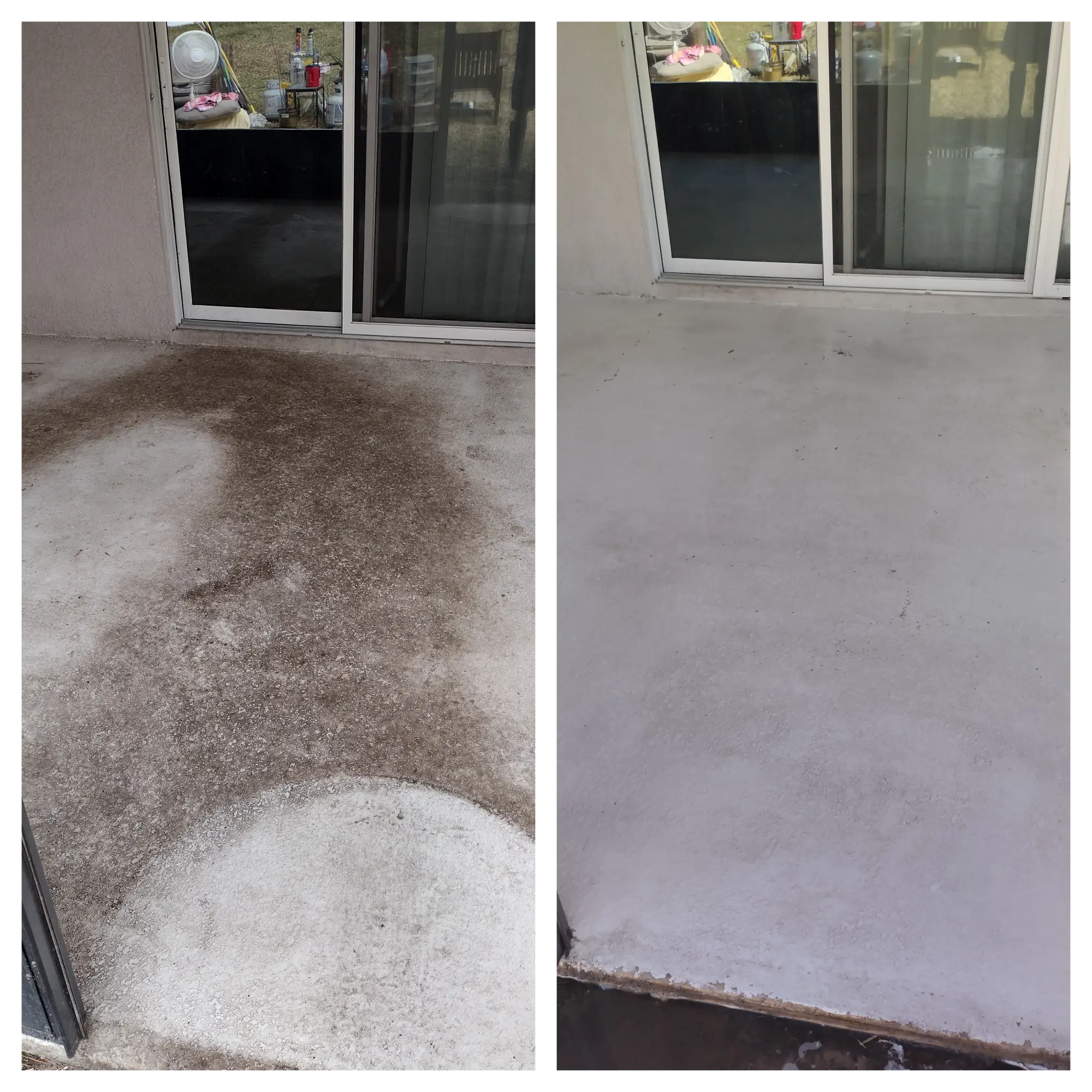
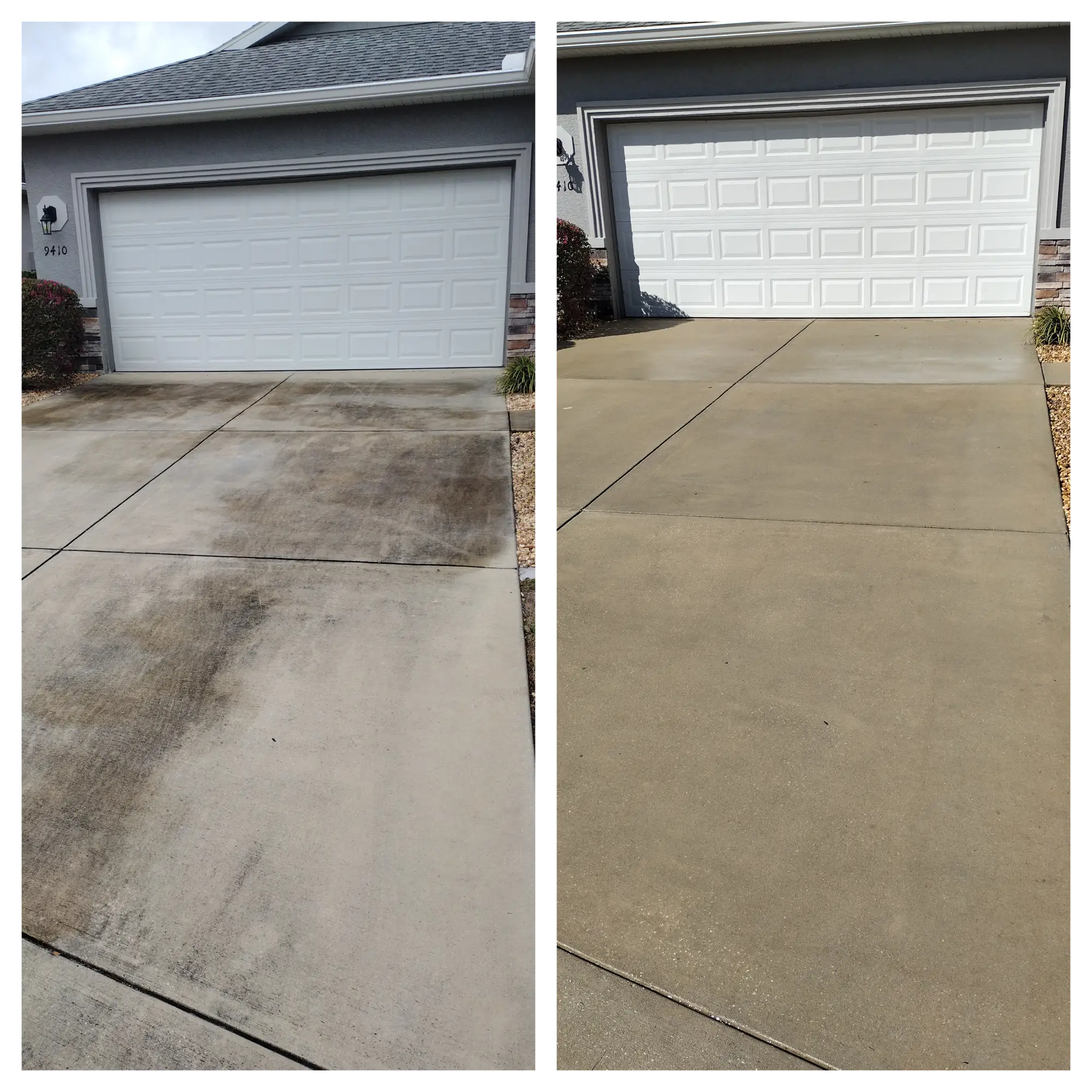
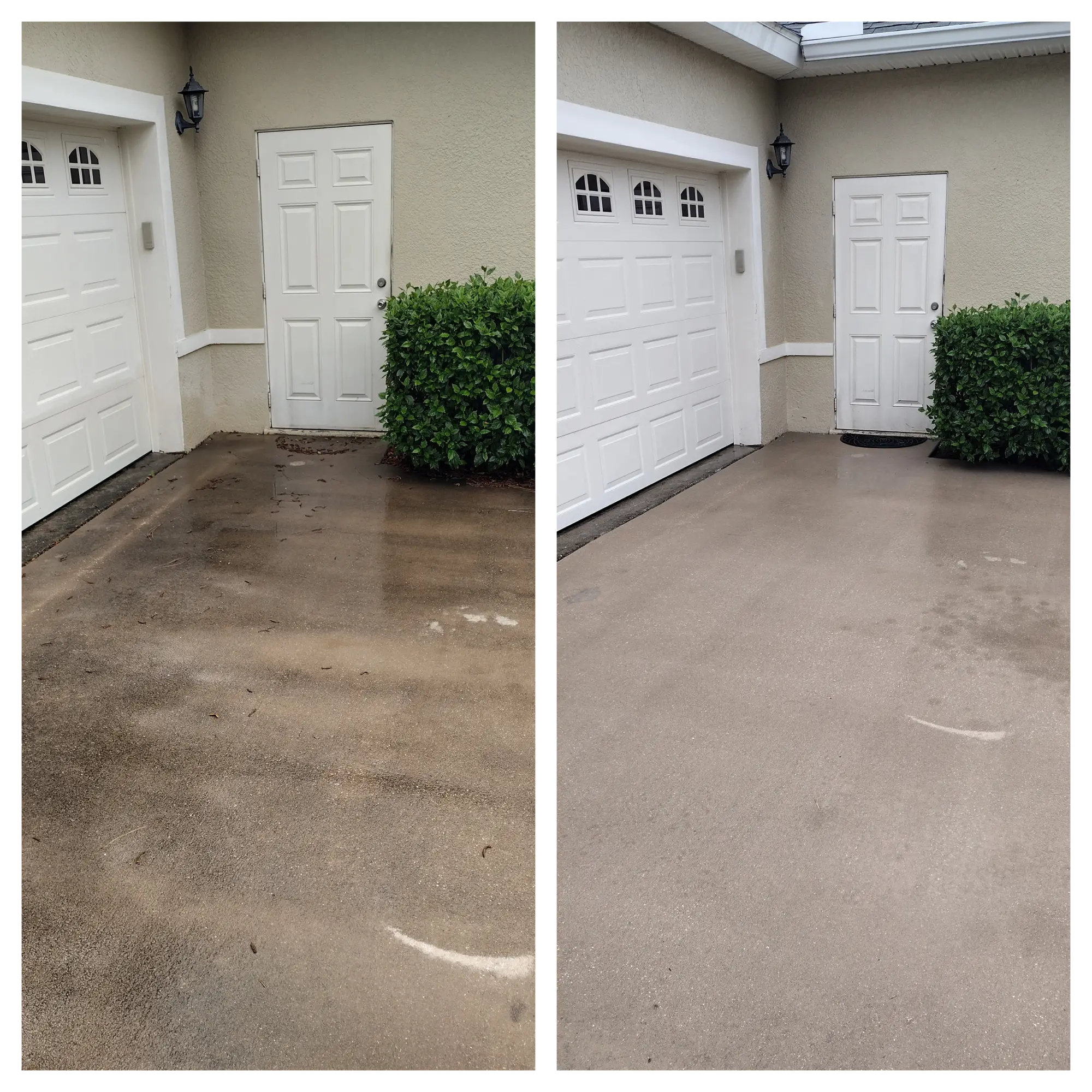
Why sealing matters here: The concrete driveway is the highest-traffic concrete surface on a residential property and the one that most visibly signals property maintenance quality to anyone driving by. Oil from vehicles, rust from well water irrigation spray, tire wear, and UV degradation combine to produce the gray-brown-orange stained driveway surface that is the most common concrete appearance problem in established Ocala neighborhoods. Sealing creates the barrier that prevents oil, rust, and staining compounds from penetrating on contact.
Recommended sealer approach: Penetrating silane/siloxane sealer is the standard for Florida concrete driveways — breathable, durable under vehicle traffic, and effective at preventing liquid penetration including oil, fuel, and rust from irrigation. For colored or stamped driveways, UV-stable acrylic in appropriate sheen level.
Special consideration: New concrete driveways should be sealed after a minimum of 28 days of cure time. Sealing before full cure traps residual water from the curing process under the sealer. For existing driveways, any oil staining should be treated with degreaser before sealing — sealing over oil staining locks the stain in permanently. We assess staining before sealing and treat as needed.
Patio and Outdoor Living Concrete -- UV, Staining, and Biological Growth
Why sealing matters here: Patio concrete takes the full combination of Florida challenges: direct UV exposure, biological growth from shade and moisture, tannin staining from leaf debris, and fertilizer runoff from adjacent lawn areas. Patios are often partially shaded by mature trees — the shade that creates comfort also creates the moisture retention conditions that biological growth requires. Unsealed patio concrete in established Ocala neighborhoods develops the green biological film and orange rust tinting that makes outdoor living areas look neglected.
Recommended sealer approach: Penetrating sealer for standard patio concrete. Acrylic in chosen gloss level for colored or decorative patio concrete. The sealer choice for patio surfaces can include a gloss option that enhances the patio’s appearance — unlike driveways where natural gray concrete does not benefit dramatically from gloss, patios are often used as aesthetic focal points where a modest color enhancement is welcome.
Special consideration: Patio concrete is frequently adjacent to landscaping and lawn areas. Confirm that sealer is compatible with adjacent plant material — most professional concrete sealers are plant-safe after cure, but runoff during application should be directed away from landscape beds.
Sidewalks and Walkways -- Traffic, UV, and Biological Growth
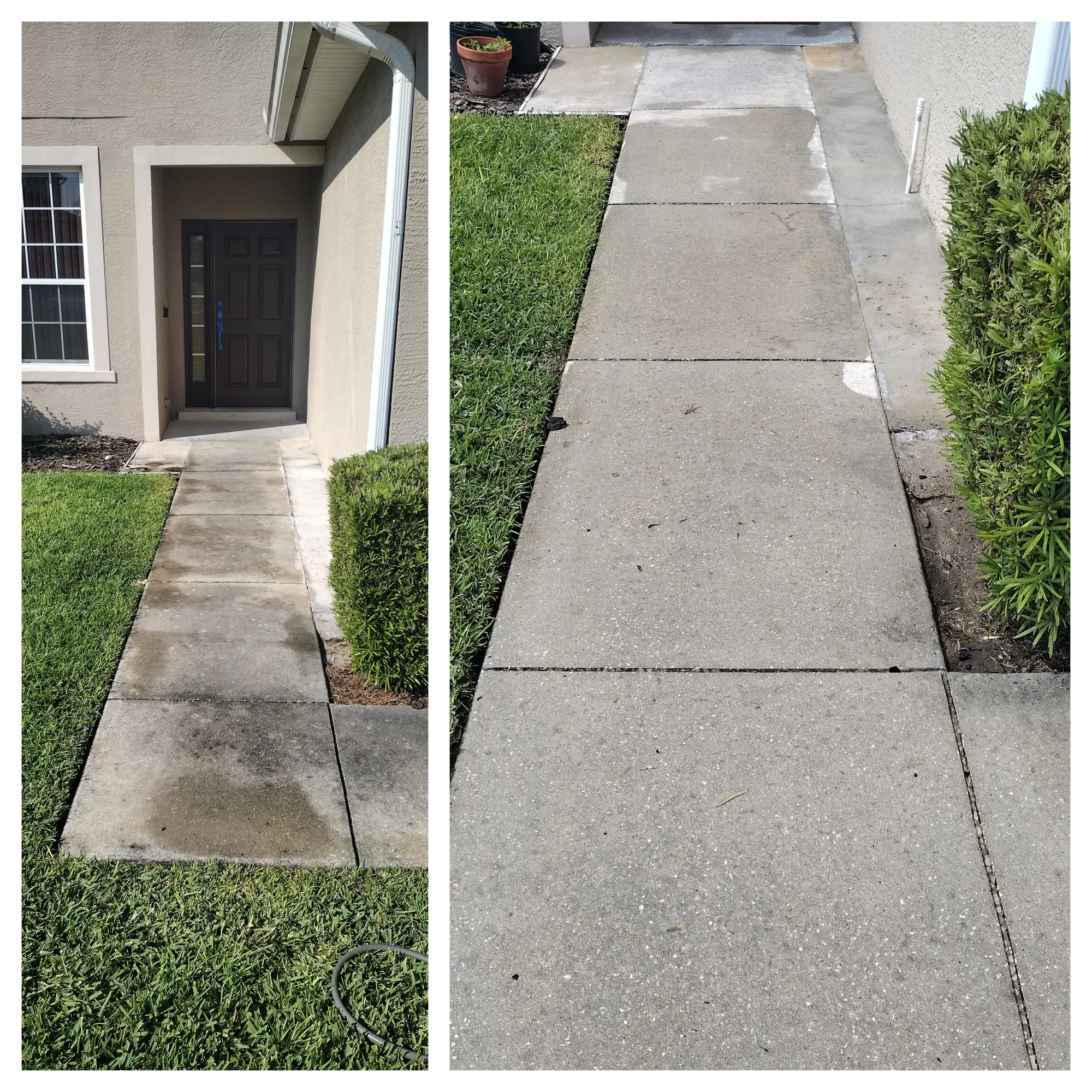
Why sealing matters here: Sidewalks and walkways accumulate foot traffic wear, biological growth in shaded sections, rust staining from adjacent irrigation systems, and fertilizer staining from adjacent lawn treatment. Unsealed sidewalk concrete becomes progressively rougher from surface erosion under foot traffic, creating a surface that accumulates dirt, staining, and biological growth more aggressively than a smooth sealed surface. The difference in ease of cleaning between sealed and unsealed walkway concrete after a season of use is substantial.
Recommended sealer approach: Penetrating sealer for exterior walkways — same vapor permeability argument as any exterior Florida concrete. The invisible protection of penetrating sealer is appropriate for sidewalk applications where aesthetic enhancement is secondary to durability and ease of maintenance.
Special consideration: Shaded sections of walkways that receive no direct sun require cleaning before sealing to address established biological growth, then sealing to prevent rapid regrowth. Shaded sealed concrete resists biological growth re-establishment significantly longer than shaded unsealed concrete.
Garage Floor Concrete -- Chemical Resistance and Durability
Why sealing matters here: Garage floor concrete faces a distinct set of challenges: vehicle fluids including oil, fuel, brake fluid, and battery acid; tire wear and scuffing from vehicle movement; and the visual impact of a working space that spends years absorbing whatever spills on it. Standard gray garage floor concrete after years of vehicle use develops a pattern of staining and rough texture that no cleaning alone can fully restore. Sealing before significant contamination is the most cost-effective approach.
Recommended sealer approach: Polyurethane or epoxy-enhanced sealer for interior garage floors — the superior chemical resistance and abrasion durability of thicker coating systems is appropriate for the chemical exposure and mechanical wear of vehicle traffic. Vapor permeability is less critical for garage floors, which typically have better drainage and less ground moisture exposure than exterior grade-level concrete.
Special consideration: Existing oil staining on a garage floor must be degreased and treated before sealing. Sealing over contaminated concrete bonds the contamination to the surface permanently. For heavily stained garage floors, cleaning and degreasing before sealing produces a result significantly better than sealing alone.
All Paver Types. More Scheduling Flexibility Because the Sealer Is Built for Florida.
PAVER SURFACES WE SEAL
Concrete pavers — the most common paver type in Ocala-area driveways, patios, walkways, and pool decks. Manufactured concrete pavers respond well to professional sealer and show the most dramatic color enhancement from wet look finish. Joint stabilization through the sealer film is particularly effective on concrete pavers because of the consistent joint width of manufactured products.
Brick pavers — clay brick installed in driveways, pathways, and accent areas. Color enhancement on brick produces the deep rich red-brown that makes sealed brick one of the most visually striking paver finishes available.
Travertine — natural limestone-family stone used in upscale pool decks, patios, and outdoor living areas. Travertine is more porous than concrete or brick pavers and requires a penetrating sealer appropriate for natural stone. Travertine sealed correctly resists biological growth, pool chemical staining, and maintains its natural stone appearance for years longer than unsealed travertine in Florida’s climate.
THE FLORIDA SEALING CALENDAR
November through May is the optimal sealing window. But Randy’s moisture-compatible sealer gives more flexibility year-round.
Standard paver sealers require completely dry surfaces — in Florida’s summer wet season, that can mean waiting 24 to 48 hours after cleaning before sealing is possible, and scheduling around daily afternoon thunderstorms to protect the cure window. The moisture-compatible sealer Randy uses eliminates the dry-time constraint, which means clean-and-seal scheduling is achievable in a wider range of Florida weather conditions than a standard sealer contractor can offer.
November through May remains the optimal window because lower overall humidity and reduced rain frequency make scheduling and cure more predictable. But for homeowners who need sealing outside this window — pre-sale preparation, post-construction completion, or protecting pavers before the wet season — the moisture-compatible product gives us more scheduling options than most contractors in the Ocala market.
5-Star Rated on Google & Yelp
Trusted by Homeowners Across Marion, Citrus, Levy & Sumter Counties
Posted on Google
 Brandon Fairley
Trustindex verifies that the original source of the review is Google.
Randy and his team are true pros when it comes to power washing. They take the time to do the job right and treat your property with care. Highly recommend!Posted on Google Chad FilleyDoes and great job, extremely thorough job on a drive way and house.Posted on Google
 Gary StrikerStars and Stripes Power Washing does incredible work. Randy and his crew did an outstanding job on my horse trailer. It looks brand new. He is professional, shows up on time, paid attention to the details, and left everything clean when he finished. I’m a realtor, and I recommend Randy and Stars and Stripes Power Washing to all of my clients who need power washing. Reliable, high quality work every time..Posted on Google
 Gus BlancoWe own Complete Dryer Vent Services LLC and were really impressed with the work these guys performed. I can't believe how dirty my vinyl fence was. A week later and it's still glowing white! Got a good education on how lichen can cause staining and damage protective coating on vinyl fence. These guys know their stuff. They even washed our work trailer! Highly recommend Starr's and Stripes.Posted on Google
 Michael FetchRandy and Mathew from Starr's and Stripes Power Wash did an excellent job on our full house wash. Communication was clear and easy from start to finish, and they took the time to protect the plants and landscaping around the house. Our roof shingles had streaks all over them and now they are completely gone — the roof and house both look amazing. Honestly looks like a brand new home again. I would absolutely recommend them to anyone looking for pressure washing done right.Posted on Google
 Crystal LyonsReally great people! Prompt, courteous and professional while still being personable. Highly recommend!!! Edited to add that we are now repeat customers and our rating hasn't changed a bit! Same promptness, courtesy and professionalism!Posted on Google
 Kevin MckenzieRandy was very professional, friendly and thorough. I would highly recommend Starr's & Stripes Powerwash to anyone needing their home, roof or driveway cleaned.Posted on Google
 Angela NortonStarr's & Stripes PowerWash exceeded my expectations! Randy's team transformed my property, leaving everything spotless and looking brand new. Their attention to detail and dedication to quality are impressive. If you need reliable and thorough exterior cleaning, look no further—these guys are the best in the business!Posted on Google
 Mary RossiAbsolutely the nicest people to deal with and a great job.Posted on Google
 Jeannine PlummerI am a local Realtor, and I love that I can trust Starrs & Stripes to do a great job and with such professionalism that my clients reach out singing their praises after they leave. I highly recommend using this company for all of your power washing needs!
FAQs
Questions About Paver Sealingin Ocala, Florida
Why did my concrete sealer peel and blister in Florida?
The most common cause of concrete sealer failure in Florida is vapor pressure from ground moisture beneath the slab. Exterior concrete in Florida sits on grade with constant soil moisture below it. That moisture moves upward through the slab as vapor. A non-breathable film-forming sealer — the type sold at most hardware stores — traps this vapor under the sealer film. Vapor pressure builds beneath the film until it delaminates, creating the bubbles, blisters, and peeling sections that are the signature of vapor pressure failure. Professional sealing in Florida uses breathable sealer chemistry: penetrating silane/siloxane for most exterior applications, which bonds inside the concrete pore structure and allows moisture vapor to pass through while blocking liquid water penetration. The correct product does not trap moisture and therefore does not fail this way.
Does concrete sealing actually prevent cracks?
Sealing prevents specific types of surface deterioration that can lead to cracking, but it does not prevent all cracking. What sealing does: it stops moisture intrusion that weakens the concrete matrix over time, prevents surface spalling (surface flaking from moisture cycling), and protects against biological acids and chemical attack that degrade the surface chemistry. Early-stage hairline cracks that are present before sealing will be stabilized — the sealer fills the crack faces and prevents water from entering and enlarging the crack through moisture cycling. What sealing does not prevent: structural cracking from soil movement, tree root pressure, improperly cured concrete, or loads beyond the concrete’s design capacity. Those are structural issues that sealing does not address. Cracks that are present before sealing should be filled and repaired before the sealing job.
How long should I wait before sealing new concrete?
New concrete should cure for a minimum of 28 days before sealing. During the cure period, water from the concrete mix is still evaporating from the slab — sealing before full cure traps this water under the sealer and creates the same vapor pressure failure mode as sealing over ground moisture. In Florida’s humidity, the 28-day minimum should be extended if the cure period includes sustained high-humidity weather that slows moisture evaporation from the slab. Post-construction sealing as part of a new installation completion is best scheduled 30 to 45 days after the concrete pour to ensure full cure.
What is the water bead test for concrete sealing?
The water bead test is the simplest way to determine whether a concrete surface has active penetrating sealer protection. Pour a small amount of water on the concrete and watch for 5 to 10 minutes. If the water beads up and sits on the surface without being absorbed — similar to water on a freshly waxed car — the sealer is still active and providing protection. If the water is absorbed into the concrete and the surface darkens, the sealer has worn away and resealing is needed. This test works specifically for penetrating sealers. For film-forming acrylic sealers, visual signs of wear — loss of sheen, visible surface erosion — are the primary resealing indicators.
Can you seal concrete that has oil stains on it?
Oil staining on concrete must be treated before sealing. Sealing over an oil stain bonds the contamination to the surface permanently — it will not be removable after the sealer is applied over it. We treat oil staining with professional degreaser before sealing to break down and remove as much of the penetrated oil as possible. Heavy oil saturation that has soaked deeply into the concrete matrix may not be completely removable, but surface treatment before sealing is always performed. We assess the degree of oil penetration at the estimate visit and advise honestly on the expected result before beginning any cleaning and sealing work.
How often does concrete need to be resealed in Florida?
Penetrating silane/siloxane sealer on Florida exterior concrete typically lasts 3 to 5 years before the water bead test shows absorption returning. Acrylic sealer on decorative or stamped concrete typically requires reapplication every 2 to 3 years in Florida due to UV exposure and traffic wear. Garage floor polyurethane or epoxy systems last 3 to 5 years with normal vehicle traffic. The practical recommendation for most Ocala homeowners is a 3-year resealing schedule for penetrating exterior sealer, and a 2-year schedule for acrylic decorative sealer. Signs that earlier resealing is needed: the water bead test shows absorption, visible surface erosion, increased staining frequency, or biological growth returning faster than after the previous sealing.
Is concrete sealing necessary in Florida or is it optional?
In Florida’s climate, exterior concrete sealing is a maintenance necessity, not an optional enhancement. The combination of high UV intensity, year-round moisture cycling, sustained biological growth conditions, and staining compounds from irrigation, lawn maintenance, and vehicle traffic creates a degradation environment that operates on unsealed concrete twelve months per year with no seasonal relief. Unsealed concrete in Florida deteriorates faster than in most other climates. The cost of replacement — to 2 per square foot for a standard driveway, 5 to 5 for stamped concrete — dwarfs the cost of periodic sealing. Property owners in the Ocala area who maintain sealed concrete surfaces consistently report significantly better condition at 10 and 15 years than comparable properties with unsealed concrete.
How much does concrete sealing cost in Ocala?
Concrete sealing pricing depends on the surface area, the concrete type, and whether cleaning is included. A standard residential concrete driveway of 400 to 600 square feet typically ranges from 00 to 00 for clean and seal. A concrete patio or pool deck of 300 to 500 square feet ranges from 75 to 50. Stamped or decorative concrete is priced at a higher rate due to the acrylic sealer product cost and the care required to preserve surface detail. Garage floor sealing with polyurethane or epoxy product is priced after an on-site assessment based on floor condition and area. All pricing is provided as a written free estimate after on-site measurement. Call or text (352) 230-9299.