SOLAR PANEL CLEANING IN OCALA AND ALL FOUR COUNTIES FOR POLLEN AND BIRD DROPPING REMOVAL, WARRANTY-SAFE LOW-PRESSURE METHOD, DEIONIZED WATER RINSE TO RESIDENTIAL ROOFTOP PANELS
Get Every Watt Your Panels Are Designed to Produce.
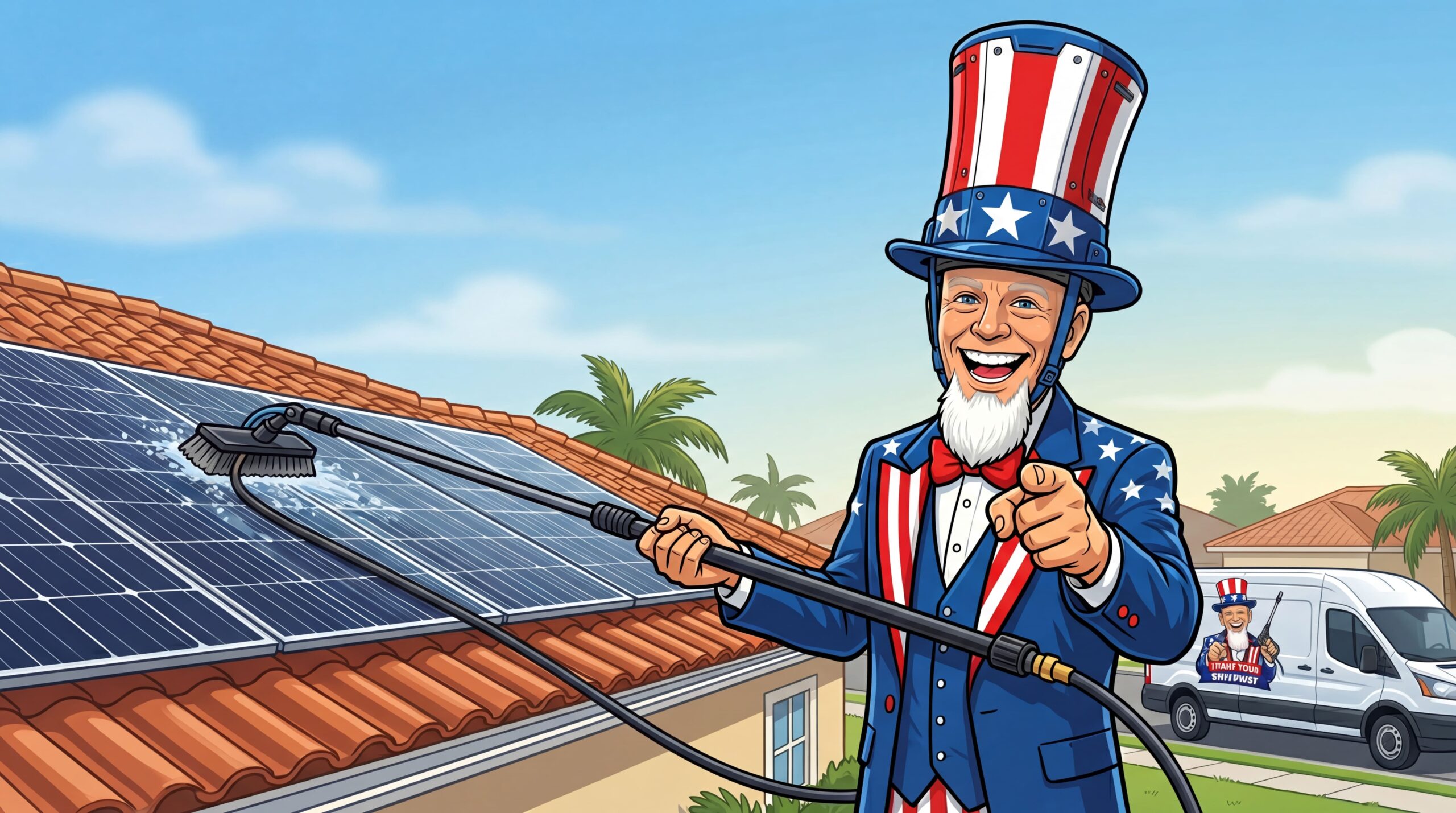
Looking for professional solar panel cleaning in Ocala, Florida? Starr's & Stripes Power Wash provides specialized pure-water solar panel washing for residential roofs and commercial arrays across Marion, Sumter, Citrus, and Levy Counties. Owners Randy and Matt Starr deliver chemical-free, scratch-free cleaning using de-ionized water and soft-bristle brushes—eliminating sticky oak pollen, bird droppings, dust film, and hard water spots to restore maximum energy efficiency.
Maximize Solar Performance
Solar panel owners in the Ocala area make a significant investment in clean energy production. That investment produces its return month by month through reduced electricity costs — but only if the panels are operating at their designed output capacity. Florida’s combination of heavy pollen seasons, year-round bird activity, and humidity-driven biological growth creates soiling conditions that routine rainfall does not fully address. Pollen bonds to panel glass and does not wash off in rain. Bird droppings block individual cells entirely and create hotspot conditions that drag down the entire string. Algae and mold growth at panel edges and frames migrate onto glass over time.
Starr’s & Stripes provides professional solar panel cleaning with low-pressure purified water technique calibrated for solar panel glass surfaces and manufacturer warranty compliance. No abrasive tools. No high-pressure stream that forces water into panel seals. No mineral-deposit tap water that leaves spots on anti-reflective glass coatings. Clean panels, maximum output, warranty intact.

Florida Rain Cleans Dust.It Does Not Clean These Four Things.
The most common reason solar panel owners defer cleaning is the reasonable assumption that Florida rain handles it. For routine dust, that is partially true — rain provides some natural self-cleaning on angled panels. But Florida’s four primary panel soiling sources are not dust. They are contaminants that bond to glass, block individual cells, or accumulate at panel edges in ways that rainfall does not address. These four conditions are why Florida solar panels benefit from professional cleaning even in a high-rainfall environment.
Pollen Film -- The Invisible Efficiency Thief
How it accumulates: Central Florida’s extended oak and pine pollen seasons run from February through May with a secondary season in fall. During peak pollen periods, pollen deposits on horizontal and near-horizontal surfaces at rates visible to the naked eye — the yellow-green film on car hoods and patio furniture is the same material accumulating on solar panel glass. Panel glass is a particularly effective pollen trap because the anti-reflective coating creates a slightly textured surface that pollen particles adhere to.
Why rain does not remove it: Pollen particles are sticky by design — their function is to adhere to surfaces they contact. Rain moves some pollen off angled panels but does not dissolve the film that has bonded to the glass surface. After a rain event, the pollen that was not dislodged dries as a thin, uniform film that reduces light transmission across the entire panel surface rather than in isolated spots.
Efficiency impact: A uniform pollen film across the panel surface reduces light transmission to every cell simultaneously. Unlike a bird dropping that blocks one area, pollen film reduces total output proportionally across the panel. During a heavy pollen season, Florida solar panels operating without cleaning can accumulate film visible from the ground. Each percentage point of light transmission reduction equals approximately the same percentage point of output reduction.
Bird Droppings -- Localized Hotspots That Punish the Whole String
How it accumulates: Florida’s year-round warm climate supports continuous bird activity, and solar panels on rooftops are prime perching and roosting surfaces for birds. Bird droppings accumulate on panel glass throughout the year with no seasonal break. Unlike pollen, which distributes uniformly, bird droppings are localized — but their efficiency impact is disproportionate to their size.
Why rain does not remove it: Bird droppings are acidic and dry to a hard, bonded deposit on glass within hours of deposit. Rain softens fresh droppings partially but does not remove dried, bonded material. Droppings that have dried in Florida heat are effectively cemented to the glass surface and require physical cleaning to remove.
Efficiency impact: A bird dropping covering even 1-2% of a panel’s surface area can cause a disproportionate output reduction if the affected cells are wired in series with the rest of the string. Photovoltaic cells in series behave like links in a chain — the lowest-performing cell limits the output of the entire string. A single bird dropping creating a localized shadow on a critical cell can reduce string output by 10-40% depending on system configuration. This is called the hotspot effect and is the reason bird dropping removal is the highest-priority solar panel cleaning task in Florida.
Biological Growth -- The Slow Accumulation at Panel Edges
How it accumulates: Florida’s year-round humidity and warm temperatures create ideal conditions for algae, mold, and biological growth at the panel frame and mounting hardware level. The frame perimeter where the panel glass meets the aluminum frame is a protected zone where moisture collects, organic debris accumulates, and biological growth establishes itself. Over months and years, biological growth at the frame perimeter migrates inward onto the glass surface.
Why rain does not remove it: Biological growth at panel edges and frames is protected from rainfall impact by the panel frame itself — the rain washes the center of the glass but the frame perimeter zone stays wet and biologically active. Algae and mold that have established at the frame migrate onto the glass surface in the biological growth front that moves inward from the edges over time.
Efficiency impact: Biological growth on panel glass creates both a physical light transmission barrier and a potential long-term glass surface issue. Algae and mold produce acids that can etch glass surfaces over extended contact periods. Edge growth that migrates 1-2 cm inward across the panel perimeter can reduce the effective active area of each panel by several percent. On a 20-panel system, the compounding effect of edge growth is measurable in monthly production data.
Roof-Wash Runoff and Organic Debris
How it accumulates: Solar panels are installed on roofs that accumulate the same biological growth, oak leaf debris, pine needle deposits, and organic material as any Florida roof surface. During rain events, runoff from the roof surface above the panels carries organic debris, algae spores, and biological growth residue across the panel glass. Homes with significant tree canopy — common in Ocala’s established neighborhoods — experience high organic debris loads on both the roof and the panels below the canopy.
Why rain does not remove it: Roof-wash runoff leaves organic debris and biological spore deposits on panel glass. These deposits are not washed off by subsequent rain — they were deposited by rain. Organic debris in panel frame perimeters creates the nutrient base that accelerates biological growth at panel edges.
Efficiency impact: Roof-wash runoff contamination compounds with every rain event if not periodically cleaned. Homes with metal roofs that accumulate rust-colored tannin staining from oak leaf debris will see the same orange-brown discoloration on panels below the affected roof sections. This contamination reduces light transmission and is not addressed by rainfall. Coordinating solar panel cleaning with roof cleaning eliminates both the panel contamination and the source of ongoing roof-wash runoff.
The Math on Solar Panel Cleaning Is Simple. And It Strongly Favors Cleaning.
Solar panel owners make the ROI calculation on professional cleaning the same way they made the initial installation decision: does the cost produce a positive return? For most Florida residential systems, the answer is clearly yes — and the margin is not close. Here is the calculation across three typical Ocala residential system sizes.
The calculations below use a conservative 15% soiling efficiency loss estimate — well within the range documented by the National Renewable Energy Laboratory (NREL), which cites up to 25% efficiency loss from soiling. The actual efficiency loss on your system depends on panel age, tilt angle, tree canopy exposure, and how long since the last cleaning. A system that has not been cleaned since installation likely has a higher loss than these conservative estimates.
Small Residential System -- 6 kW
Solar system value: 5,000 to 8,000 installed
Estimated soiling efficiency loss: 15% soiling loss (conservative NREL estimate)
Annual energy value lost to soiling: 80 to 40 per year in lost energy value at Florida average electricity rates
Professional cleaning cost: 25 to 75 for professional cleaning
Net annual benefit of cleaning: 5 to 15 net positive in year one, recurring annually
Mid-Size Residential System -- 10 kW
Solar system value: 2,000 to 8,000 installed
Estimated soiling efficiency loss: 15% soiling loss (conservative NREL estimate)
Annual energy value lost to soiling: 00 to 00 per year in lost energy value at Florida average electricity rates
Professional cleaning cost: 50 to 25 for professional cleaning
Net annual benefit of cleaning: 50 to 75 net positive in year one, recurring annually
Large Residential System -- 15 kW
Solar system value: 2,000 to 2,000 installed
Estimated soiling efficiency loss: 15% soiling loss (conservative NREL estimate)
Annual energy value lost to soiling: 50 to 00 per year in lost energy value at Florida average electricity rates
Professional cleaning cost: 75 to 75 for professional cleaning
Net annual benefit of cleaning: 75 to 25 net positive in year one, recurring annually
These calculations use conservative efficiency loss estimates and do not account for the additional value of removing bird dropping hotspots, which can cause disproportionate output reduction beyond the uniform soiling loss. A system with active bird dropping accumulation on critical cells is likely losing more output than the soiling loss estimate alone suggests.
Professional Cleaning Protects Your Panels While Maximizing Their Output..
Solar panel glass has an anti-reflective coating designed to maximize light transmission to the photovoltaic cells beneath. That coating is effective but not indestructible. The way panels are cleaned determines whether the cleaning restores their designed output or introduces new problems. Professional solar panel cleaning is defined by three things that distinguish it from garden hose washing: pressure calibration, water purity, and surface contact method.
1
Low-Pressure Purified Water Technique
Why this approach: Solar panel manufacturer warranties specify maximum cleaning pressure limits -- typically far below standard pressure washing levels. The glass surface and frame seal perimeters are designed for weather exposure, not direct high-pressure water stream. Forcing high-pressure water into frame seal perimeters can compromise the seal and allow moisture ingress into the panel junction box, voiding the manufacturer warranty. Method: Low-pressure purified or deionized water delivery to the panel glass surface. Pressure calibrated to manufacturer specifications. Purified or deionized water removes the mineral content in tap water that leaves spotting residue on glass surfaces after drying. The deionized water rinse produces a spot-free finish that does not re-reduce light transmission with mineral deposits after cleaning. Result: Panel glass clean of pollen film, bird dropping residue, and biological growth without any pressure-related seal compromise. Spot-free finish from purified water rinse. Warranty-compliant cleaning approach.
2
Non-Abrasive Surface Contact
Why this approach: Solar panel anti-reflective coating scratches from abrasive contact. Scratched anti-reflective coating is a permanent reduction in light transmission -- it cannot be polished out or repaired. This coating is what makes clean panels more efficient than ordinary glass, and its integrity is permanent only if non-abrasive cleaning tools are used throughout the cleaning process. Method: Soft, non-abrasive applicator tools only on panel glass surfaces. No brushes with stiff bristles. No abrasive pads. No squeegees with worn or damaged edges. Surface contact tools are inspected before each use and replaced when any abrasive wear is detectable. Pre-rinse of the glass surface before any applicator contact dissolves and floats away the majority of loose contamination so the contact cleaning step works on the remaining bonded material with minimal friction. Result: Anti-reflective coating integrity preserved throughout the cleaning process. The panel glass after professional cleaning transmits the same percentage of light as when originally installed -- the coating is not degraded by the cleaning service.
3
Bird Dropping Removal Protocol
Why this approach: Dried bird droppings bonded to panel glass require a specific approach to remove without glass surface damage. Applying pressure directly to a dry bonded bird dropping drags the hard dried material across the glass surface as it is dislodged, creating a scratch pattern at the cleaning path. This is the most common source of anti-reflective coating damage from DIY solar panel cleaning attempts. Method: Pre-soak of all bird dropping locations with purified water to rehydrate and soften the bonded deposit before any surface contact. Allow sufficient dwell time for full softening -- this varies by dropping age and size, typically 2 to 5 minutes. Gentle non-abrasive removal of softened material. Post-removal rinse to clear all residue. No mechanical scraping or hard tool contact on glass surfaces. Result: Bird dropping removed without scratching the glass surface or the anti-reflective coating. Hotspot condition eliminated. Full cell output restored at all previously blocked cell locations.
One Visit. Clean Roof and Clean Panels. Address the Source and the Symptom.
Solar panels sit on the same roof surface that accumulates the biological growth, organic debris, and algae that eventually ends up on the panels through roof-wash runoff. Cleaning the solar panels without addressing the roof means the roof continues to be a contamination source for the panels. Cleaning the roof without cleaning the solar panels leaves the current panel contamination in place.
A combined roof and solar panel cleaning visit addresses both in a single mobilization. The roof cleaning removes the biological growth and organic debris that were the upstream source of panel contamination. The solar panel cleaning removes the current contamination from the panels and restores their output. After a combined visit, the panels have clean glass and the roof is no longer feeding new contamination onto them.
COMBINATION VISIT BENEFITS
Single mobilization cost shared across both services. No redundant travel or setup. Roof soft wash completed first — panels cleaned after roof rinse is complete, so no roof cleaning residue falls on freshly cleaned panels. Both services documented in a single service record. Most cost-effective approach for homeowners who need both roof and panel care.
RECOMMENDED FREQUENCY
Most Ocala-area homes with solar panels benefit from a combined roof and solar panel cleaning once per year, timed after the primary spring pollen season (May or June) when pollen accumulation is at its peak from the preceding season and before the summer wet season when high humidity accelerates biological growth. A second solar-panel-only cleaning in November or December after the secondary fall pollen season addresses that accumulation before winter. Two panel cleanings per year is the recommended program for systems under significant tree canopy or with high bird activity.
5-Star Rated on Google & Yelp
Trusted by Homeowners Across Marion, Citrus, Levy & Sumter Counties
Posted on Google
 Brandon Fairley
Trustindex verifies that the original source of the review is Google.
Randy and his team are true pros when it comes to power washing. They take the time to do the job right and treat your property with care. Highly recommend!Posted on Google Chad FilleyDoes and great job, extremely thorough job on a drive way and house.Posted on Google
 Gary StrikerStars and Stripes Power Washing does incredible work. Randy and his crew did an outstanding job on my horse trailer. It looks brand new. He is professional, shows up on time, paid attention to the details, and left everything clean when he finished. I’m a realtor, and I recommend Randy and Stars and Stripes Power Washing to all of my clients who need power washing. Reliable, high quality work every time..Posted on Google
 Gus BlancoWe own Complete Dryer Vent Services LLC and were really impressed with the work these guys performed. I can't believe how dirty my vinyl fence was. A week later and it's still glowing white! Got a good education on how lichen can cause staining and damage protective coating on vinyl fence. These guys know their stuff. They even washed our work trailer! Highly recommend Starr's and Stripes.Posted on Google
 Michael FetchRandy and Mathew from Starr's and Stripes Power Wash did an excellent job on our full house wash. Communication was clear and easy from start to finish, and they took the time to protect the plants and landscaping around the house. Our roof shingles had streaks all over them and now they are completely gone — the roof and house both look amazing. Honestly looks like a brand new home again. I would absolutely recommend them to anyone looking for pressure washing done right.Posted on Google
 Crystal LyonsReally great people! Prompt, courteous and professional while still being personable. Highly recommend!!! Edited to add that we are now repeat customers and our rating hasn't changed a bit! Same promptness, courtesy and professionalism!Posted on Google
 Kevin MckenzieRandy was very professional, friendly and thorough. I would highly recommend Starr's & Stripes Powerwash to anyone needing their home, roof or driveway cleaned.Posted on Google
 Angela NortonStarr's & Stripes PowerWash exceeded my expectations! Randy's team transformed my property, leaving everything spotless and looking brand new. Their attention to detail and dedication to quality are impressive. If you need reliable and thorough exterior cleaning, look no further—these guys are the best in the business!Posted on Google
 Mary RossiAbsolutely the nicest people to deal with and a great job.Posted on Google
 Jeannine PlummerI am a local Realtor, and I love that I can trust Starrs & Stripes to do a great job and with such professionalism that my clients reach out singing their praises after they leave. I highly recommend using this company for all of your power washing needs!
FAQs
Questions About Solar Panel Cleaning in Ocala
My solar monitoring app shows lower production than last year. Could dirty panels be the cause?
Yes, and it is one of the most common causes of unexplained production decline in Florida residential systems. If your monitoring data shows lower output than the same period in a prior year, and there are no shading changes, no equipment alerts, and no obvious damage, soiling is the first thing to rule out. Florida’s pollen seasons, bird activity, and biological growth create cumulative contamination on panel glass that reduces light transmission month by month. The production decline from soiling is gradual — it does not appear as a sudden drop that triggers an alert, it appears as a slow drift in the baseline that you notice when you compare year-over-year data. A professional cleaning visit is the fastest way to determine whether soiling is the cause: if production recovers after cleaning, soiling was the issue. If production does not recover, the cause is elsewhere in the system and a solar technician should assess.
Does Florida rain clean solar panels?
Partially, but not completely. Rain provides natural cleaning for routine dust and loose debris on angled panels, which is one reason Florida residential panels do not lose output as dramatically as panels in dry desert climates. However, Florida’s primary panel soiling sources — pollen film, bird droppings, and biological growth at panel edges — are not removed by rain. Pollen bonds to panel glass and dries as a film that rain does not dissolve. Bird droppings dry to a hard, bonded deposit that rain softens but does not remove. Biological growth at panel frames is protected from rain impact by the frame itself. Professional cleaning is needed to address these specific contaminants, even in a high-rainfall environment.
Will professional cleaning void my solar panel warranty?
Not when done with the correct method. Most solar panel manufacturer warranties specify that cleaning should be performed with water only or with manufacturer-approved cleaning solutions, at pressure levels that do not force water into panel seal perimeters. Our low-pressure purified water cleaning approach is designed to comply with these requirements. We do not use high-pressure streams directed at panel frames or seal perimeters, we do not use abrasive tools that could scratch the anti-reflective coating, and we do not use cleaning chemistry that is not compatible with solar panel glass. If you have your panel warranty documentation available when scheduling, share it and we will confirm our approach is compliant with the specific requirements of your panel manufacturer.
How much output can I expect to recover after cleaning?
The output recovery after cleaning depends on the type and degree of soiling on your specific system. Florida systems with accumulated pollen film can see measurable output improvement after cleaning, particularly if the panels have not been cleaned through a full pollen season. Bird dropping hotspots that have been blocking individual cells show the most dramatic single-event recovery — removing a bird dropping from a critical cell can restore the full output of the affected string. Systems with light soiling from regular rainfall and low bird activity will see modest recovery. The most accurate answer is to check your monitoring app production data for the same time period before and after cleaning. Most solar monitoring apps allow day-by-day production comparison that makes soiling recovery visible in the data.
Can you clean solar panels at the same time as roof cleaning?
Yes, and it is the most efficient approach for homeowners who need both services. We sequence the work so roof cleaning is completed first — the roof soft wash is applied and rinsed before any panel cleaning begins, so no roof cleaning residue falls on freshly cleaned panels. After the roof rinse is complete, we clean the solar panels with the low-pressure purified water technique. A single mobilization for both services is more cost-effective than two separate visits and addresses both the current panel contamination and the upstream roof surface that was the contamination source.
How often should solar panels be professionally cleaned in Florida?
For most Ocala-area residential systems, one professional cleaning per year provides meaningful output maintenance. The optimal timing is after the primary spring pollen season — May or June — when pollen accumulation from the February through May oak and pine pollen period is at its peak. This timing also precedes the high-humidity summer season when biological growth accelerates. Systems under significant tree canopy, systems with high bird activity, or systems that have not been cleaned since installation may benefit from two cleanings per year — the spring pollen cleaning and a fall cleaning after the secondary pollen season. Check your monitoring app production data: if you see a measurable production increase after the first cleaning, your system is in the category that benefits from twice-annual service.
Is it safe to clean solar panels yourself with a garden hose?
A gentle garden hose rinse from the ground — without climbing on the roof or using any pressure attachment — is generally safe for routine loose dust removal and will not damage panels. However, it does not remove pollen film, bird droppings, or biological growth, which require either adequate water pressure and volume for full removal or specific cleaning technique. The risks of DIY panel cleaning that go beyond a ground-level hose rinse: (1) pressure nozzle attachments on a garden hose can exceed safe panel pressure limits if directed at frame seals; (2) abrasive cleaning pads or brushes scratch anti-reflective coating permanently; (3) working on a roof is a fall hazard without appropriate safety equipment; (4) tap water from a hose can leave mineral deposits on panel glass that reduce light transmission after drying. Professional cleaning removes all contaminant types with the correct chemistry and pressure, uses purified water for a spot-free finish, and does not require the homeowner to go on the roof.
How much does solar panel cleaning cost in Ocala?
Solar panel cleaning is priced by the number of panels on the system and the roof access configuration. A standard residential rooftop system of 20 to 25 panels typically ranges from 25 to 75 for a professional cleaning visit. Systems of 30 to 40 panels range from 50 to 25. Larger systems above 40 panels are priced by panel count after the estimate. Combination visits that include both roof cleaning and solar panel cleaning in a single mobilization receive a combined pricing efficiency — contact us for a combined estimate. Starr’s and Stripes provides a free estimate for all solar panel cleaning requests. Call or text (352) 230-9299 to schedule.